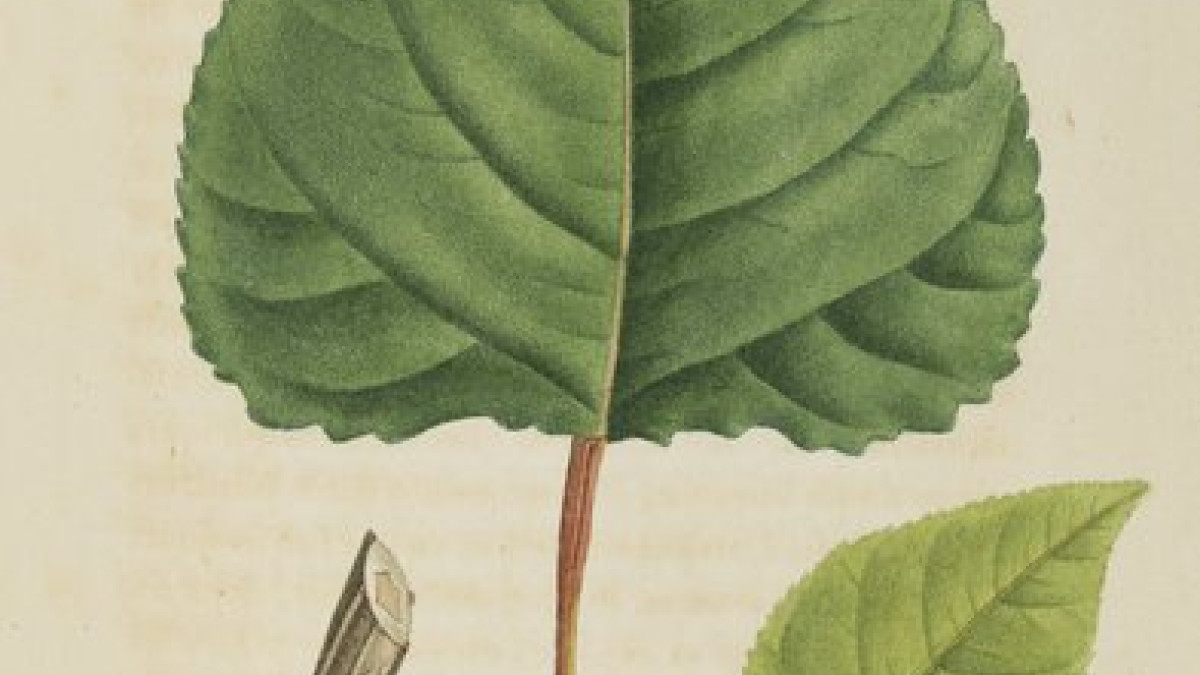




Canadian poplar

General characteristics of a Canadian poplar
The Canadian poplar is a hybrid: it is a cross between the black poplar (Populus nigra), which grows wild along our rivers, and the American poplar (Populus deltoides).
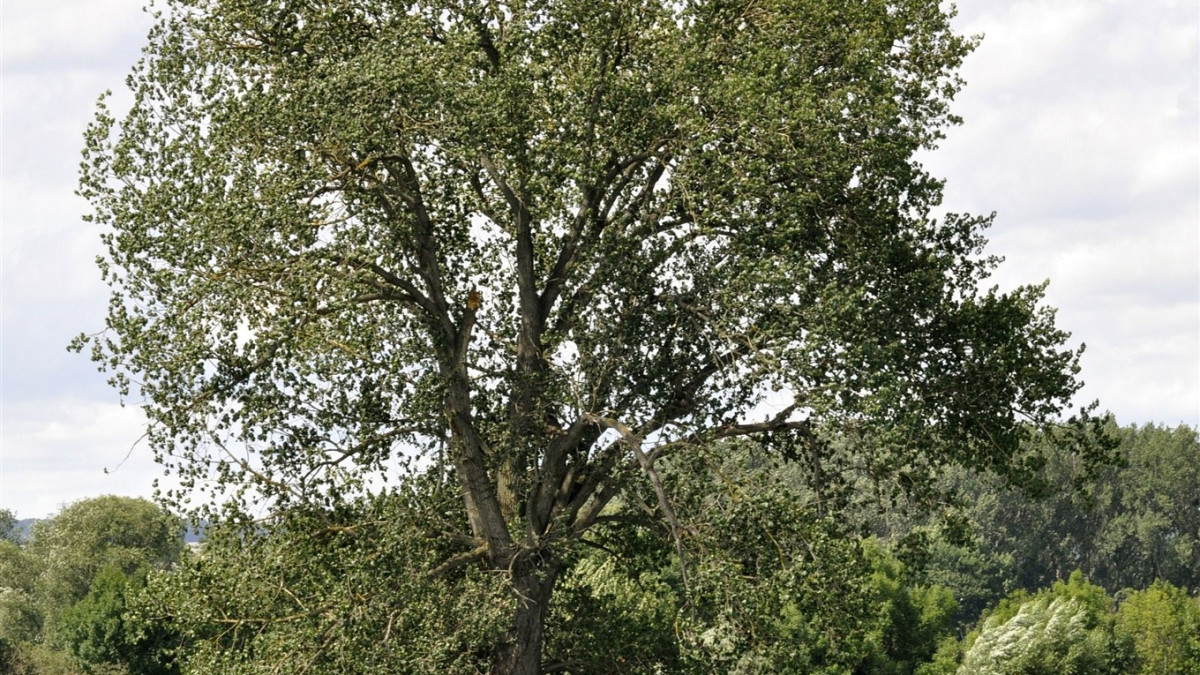
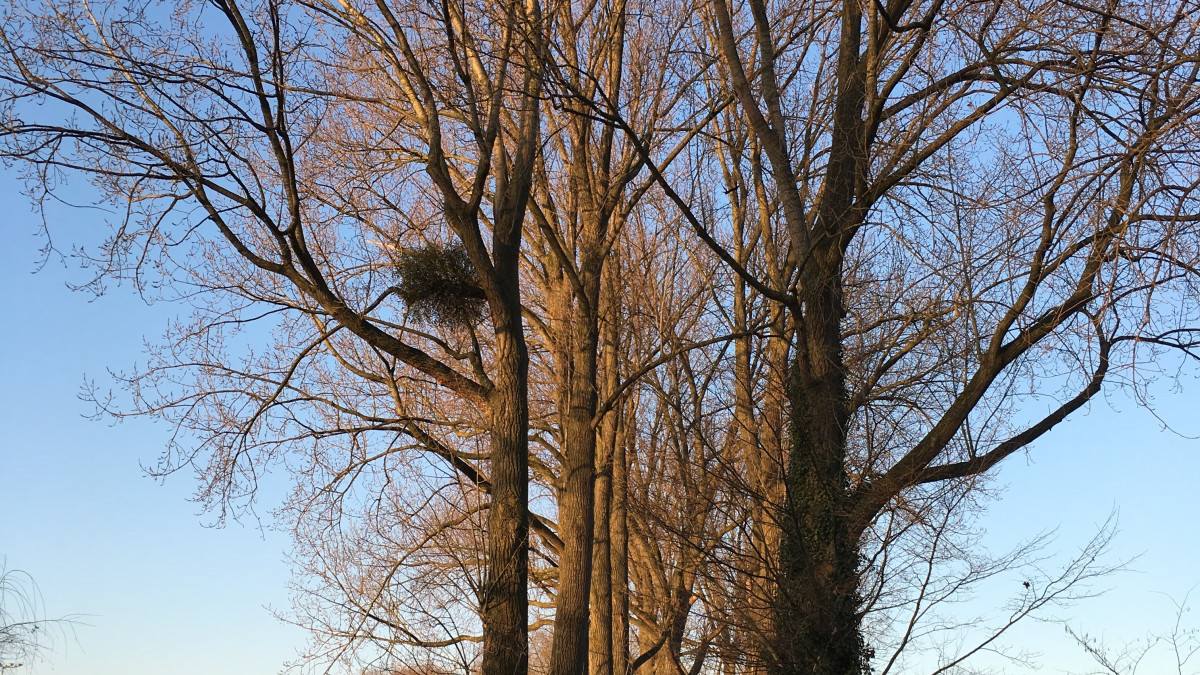
In the Dutch and Belgian landscape, the tall trees with straight trunks and open crowns are easily recognisable as Canadian poplars, Populus x canadensis. They not only form planted forest-like plantations, but are also often planted as hedgerows or along roads and canals. This creates the effect of a coulisse landscape.
The inflorescence is a hanging catkin that usually appears before the leaves sprout. Male catkins have reddish-purple stamens. They fall off quickly after releasing the pollen, which is then spread by the wind (wind pollination).
The female catkins remain hanging after pollination until May and June. Then the capsule bursts open and releases the 3 × 1 mm seed. The seed is surrounded by fluffy down.
Relatively little is known about the relationship between poplar biodiversity, but the available information shows that the poplar plays an important role for many plants and animals. For example, the poplar is an important host for many species of insects. For many butterflies, moths and beetles, the poplar is an important source of food. Research into species-specific insects in various European countries has counted between 88 and 114 species. This puts poplars in seventh place.
Characteristics
How to plant a Canadian poplar
Toch vraagt de soort om zorgvuldig beheer. Canadese populier vormt worteluitlopers en kan via zaad spontaan nieuwe bomen vestigen buiten het beheerde perceel. Vooral langs rivieren, beekdalen en open, lichte zandgronden kan hij zich lokaal invasief gedragen.
Slieten van de Canadese populier, oftewel jonge stekken of éénjarige boompjes, vormen een efficiënte manier om nieuwe aanplant te realiseren in voedselbossen of houtproductiepercelen. De beste plantperiode is in de herfst tot het vroege voorjaar, wanneer de bomen bladloos zijn en de sapstroom nog niet op gang is. Voor een goede vestiging is een zonnige locatie van belang, bij voorkeur op vochthoudende, goed doorlatende klei- of lemige zandgronden; droge zand- of veengronden zijn minder geschikt en kunnen risico’s op invasie vergroten.
Bij het planten wordt de slieet rechtop in een ruim uitgegraven gat van ongeveer 50 bij 50 centimeter gezet, met wortels gespreid en licht aangedrukt om luchtzakken te voorkomen. Gezonde slieten van 50 tot 100 centimeter lengte zijn het meest geschikt. In de eerste weken is regelmatig water geven essentieel, terwijl mulch rondom de voet helpt om vocht vast te houden en onkruid te remmen. Jongere slieten kunnen extra steun krijgen met een paal bij winderige locaties. Gedurende de eerste jaren is het belangrijk om worteluitlopers en spontaan opkomende zaailingen te verwijderen om ongecontroleerde verspreiding te voorkomen.
How to harvest a Canadian poplar
De populier kan eenvoudig worden vermeerderd via houten stekken, wat een efficiënte manier is om jonge bomen te produceren voor voedselbossen of houtproductie. De beste periode om stekken te nemen is in de winter, wanneer de boom bladloos is en in rust verkeert. Voor het nemen van stekken selecteer je gezonde, rechte takken van ongeveer 30 tot 50 centimeter lengte en met een diameter van één tot twee centimeter. Verwijder alle zijscheuten en bladeren, zodat de stek zich volledig kan richten op wortelontwikkeling.
Bij de voorbereiding van de stek wordt de onderkant schuin afgesneden en de bovenkant recht gelaten om waterafvoer te bevorderen. Optioneel kan de onderkant in wortelhormoon worden gedoopt om de beworteling te stimuleren, al is dit bij populier niet strikt noodzakelijk. Het belangrijkste is dat de stek gezond is, zonder beschadigingen of ziektes, en dat er voldoende knopen aanwezig zijn waaruit wortels kunnen ontstaan.
Caring for and pruning your Canadian poplar
Zodra de stekken van populier wortels hebben ontwikkeld en beginnen uit te lopen, is zorgvuldig onderhoud essentieel om gezonde jonge bomen te krijgen. De stekken moeten in deze fase constant vochtig worden gehouden, zodat de wortels goed kunnen ontwikkelen en uitdroging wordt voorkomen. Direct zonlicht moet worden vermeden; een lichte, beschutte plek is ideaal om verbranding van jonge scheuten te voorkomen.
Where does a Canadian poplar grow
Prefers moist soils, but does not tolerate stagnant groundwater or fluctuating groundwater levels well. Generally tolerates wet conditions in winter (e.g. due to flooding) and also tolerates calcareous soils very well.
General
| Origin |
Alien
|
| Tree Type | Deciduous tree |
Length and Age
| Length in about 10 years | 8 Up to 10 Meter |
| Reproductive Maturity in How Many Years | 15 Up to 20 year |
| Maximum Age | 100 Up to 150 year |
| Required Space | 60 Up to 100m2 |
| Growth Rate |
Reproduction
| Tree is Self-Pollinating | No |
| Reproduction Method |
Makes seedlings
|
| Reproduction rate |
|
Reproduction rate
| 1. Very low reproduction rate. The plant hardly spreads, has few seeds or vegetative spread (e.g., trees with heavy seeds). |
| 2. Low reproduction rate. Spread via limited seed production or specific conditions required |
| 3. Average reproduction rate. Regular spread, depending on wind, water, or animals, at a moderate speed (e.g., dandelion). |
| 4. High reproduction rate. Many seeds and multiple spread strategies (wind, birds, vegetative). Quickly colonizes open spaces |
| 5. Very high reproduction rate. Invasive species that spread explosively over large distances (e.g., Japanese knotweed). |
Pruning Period
| This Tree is Evergreen | No |
| Summer | No pruning in summer |
| Winter | October tot February |
| Leaf Shapes | Diamond-shaped |
| Easy to prune | No |
Bark Characteristics Seedling (50-200cm)
| Lenticels | Yes |
| Colour |
Bud Characteristics Seedling (50-200cm)
| Colour | |
| Bud Position |
Varied
|
| Bud Shape |
Pointed
|
Other
| Root |
Broad root system
Superficial rooting
|
| Bloom |
Has catkins
|
| Wind sensitivity | Not sensitive to (sea) wind |
Diseases
| Sensitive to the Following Diseases | Information not available |
Light requirement of the Canadian poplar
Suitable soil types for the Canadian poplar
| Soil type | Suitability |
|---|---|
| light clay |
|
| heavy clay |
|
| sand |
|
| peatland |
|
| Loam |
|
| Moerig op zand |
|
| Lichte zavel |
|
| Zware zavel |
|
Humidity
Suitable acidity level for the Canadian poplar
Nutritional needs of the Canadian poplar
| 1. | Very nutrient-poor soil |
| 2. | Very nutrient-poor to nutrient-poor soil |
| 3. | Nutrient-poor soil |
| 4. | Nutrient-poor to moderately nutrient-rich soil |
| 5. | Moderately nutrient-rich soil |
| 6. | Moderately nutrient-rich to nutrient-rich soil |
| 7. | Nutrient-rich soil |
| 8. | Extremely nutrient-rich soil |
| 9. | Very extremely nutrient-rich soil |
Humidity
| 1. | Extremely dry soils |
| 2. | Extremely dry to dry soils |
| 3. | Dry soils |
| 4. | Dry to dry/moist soils |
| 5. | Dry/moist soils |
| 6. | Dry/moist to moist soils |
| 7. | Moist soils |
| 8. | Moist to wet soils |
| 9. | Wet soils |
To be applied in landscapes
| Landscape | Suitability |
|---|---|
| Agroforestry |
|
| Hedge |
|
| Hedge |
|
| Forest |
|
| Feeding hedge |
|
| Back yard |
|
| Small back yard |
|
| Solitary |
|
| Wood wall |
|
Cultural-historical value
Insects
| How many insects typically live on this tree/plant? | 88 |
| Which insect groups live on this tree/plant? |
Bees
Butterflies
Hoverflies
Beetles
Wasps
Mosquitoes
|
| Are there insects dependent on this species? | No |
| Which insect species are dependent on this tree/plant? |
Birds
| Average number of birds per tree/plant? | 50 |
| Which bird groups live on this tree/plant? |
Eurasian chaffinches
fieldfares
European robins
common starlings
Woodpeckers
Common pheasants
common golden orioles
common linnets
willow warblers
common reed buntings
common wood pigeons
dunnocks
Eurasian wrens
Eurasian woodcocks
stock doves
|
Mammals
| Average number of mammals per tree/plant? | |
| Which mammal groups live on this tree/plant? |
|
| Are there mammals dependent on this species? | No |
| Which mammal species are dependent on this tree/plant? |
Bloom Period
| Summer | March Up to April |
Tree Species
| Tree species that this tree prefers to grow with |
|
Suitable for mammals?
| Mammal | Suitability |
|---|---|
| Beavers |
|
| Badgers |
|
| Squirrel |
|
| Ferret |
|
| Goat |
|
| Herbivorous rodents |
|
| Deer |
|
| Dog |
|
| Cat |
|
| Chicken |
|
| Cow |
|
| Human |
|
| Mouse |
|
| Horse |
|
| Roe deer |
|
| Sheep |
|
| Pig |
|
| Foxes |
|
| Wild boar |
|
Explanation
Explanation
Edibility
- Toxic: This tree or shrub is toxic to mammals and absolutely unsuitable for consumption.
- Very unsuitable: This tree or shrub is unsuitable for consumption by mammals and can be harmful.
- Unsuitable: This tree or shrub is generally unsuitable for consumption by mammals and can have adverse effects.
- Moderately suitable: This tree or shrub is moderately suitable as food for mammals, possibly with certain risks or limitations.
- Suitable: This tree or shrub is generally suitable as food for mammals, with little to no risks.
- Very suitable: This tree or shrub is very suitable as food for mammals, safe, and of high nutritional value.
Trunk Height
Average Trunk Height (hg) of the basal area median tree
Information not available
Trunk Diameter
(dg) (1.30m) of the basal area median tree.
Information not available
Aboveground Biomass
in whole kgInformation not available
Belowground Biomass
in whole kgInformation not available
Substance Binder
| Which substances can be bound or absorbed? |
CO2
Particulate matter
|
Carbon Attraction (kf)
| (dg) (1.30m) of the basal area median tree | Deciduous Trees (Kf = 0,48) |
Warming Resistance
| This tree is well resistant to the warming (plus 3 degrees) of our climate and fits into the future of our climate (heat and drought resistant). | No |
CO2
| 0. | not filled in |
| 1. | no storage |
| 2. | low storage |
| 3. | moderate storage |
| 4. | high storage |
| 5. | very high storage |
Fine Dust
| 0. | not filled in |
| 1. | no capture capacity |
| 2. | low capture capacity |
| 3. | moderate capture capacity |
| 4. | high capture capacity |
| 5. | very high capture capacity |
This is what an adult tree Canadian poplar looks like
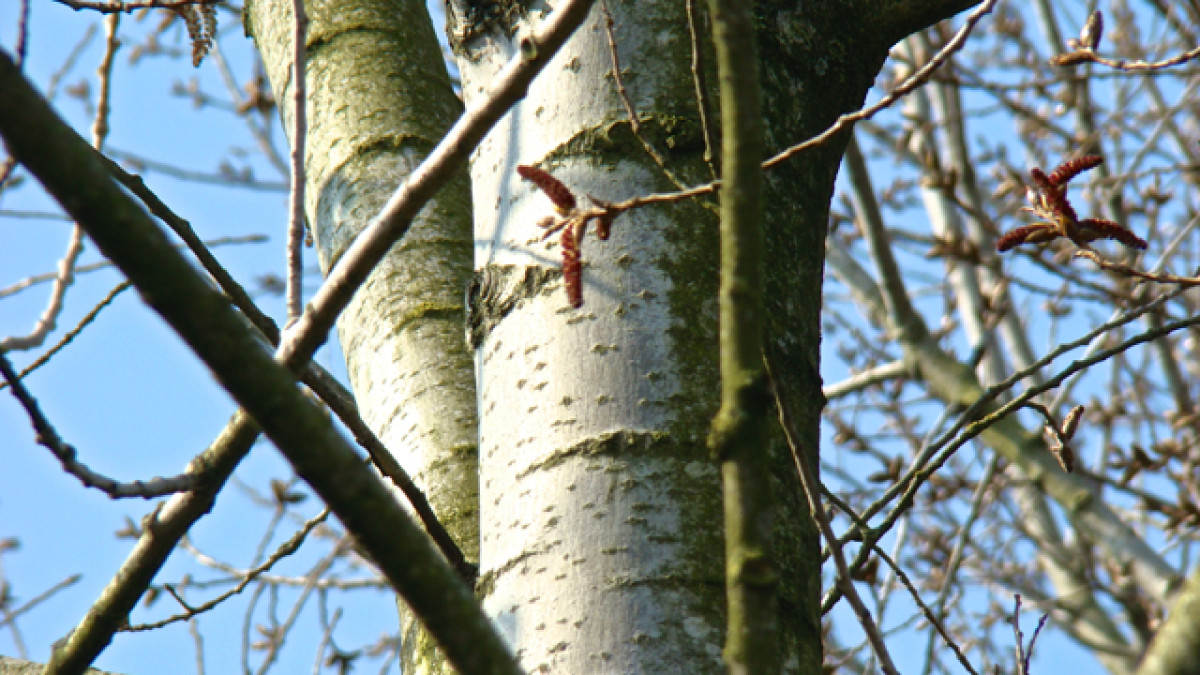
This is what a Canadian poplar in bloom looks like
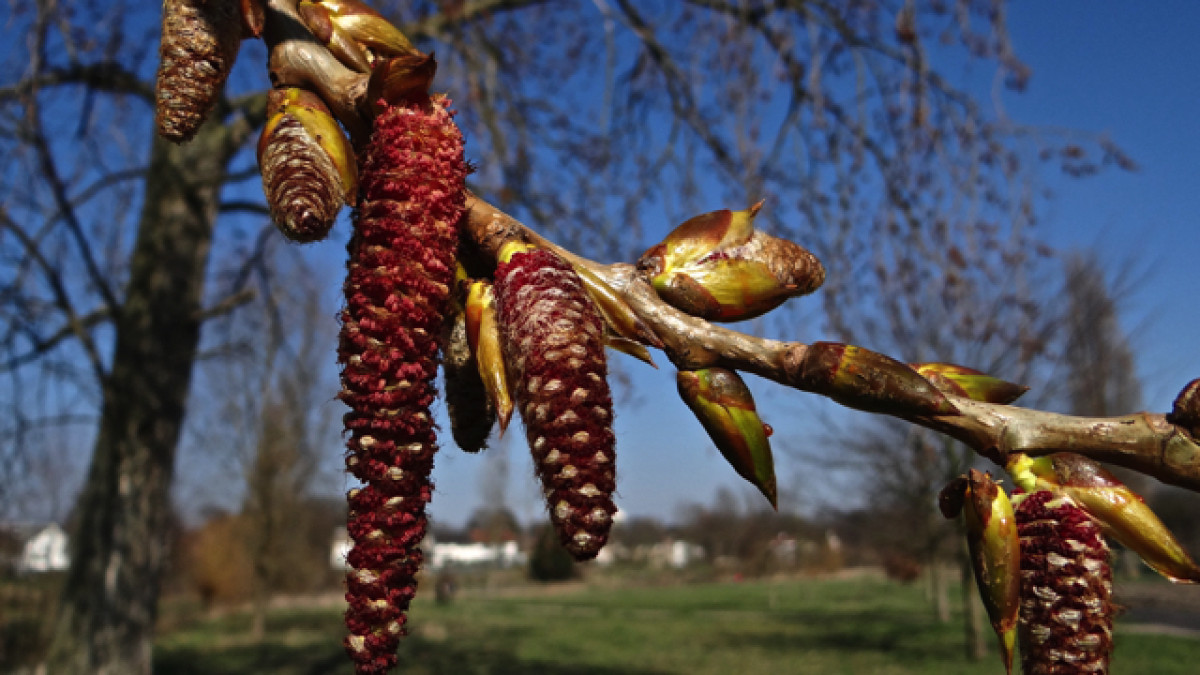
This is what the bud of a Canadian poplar looks like
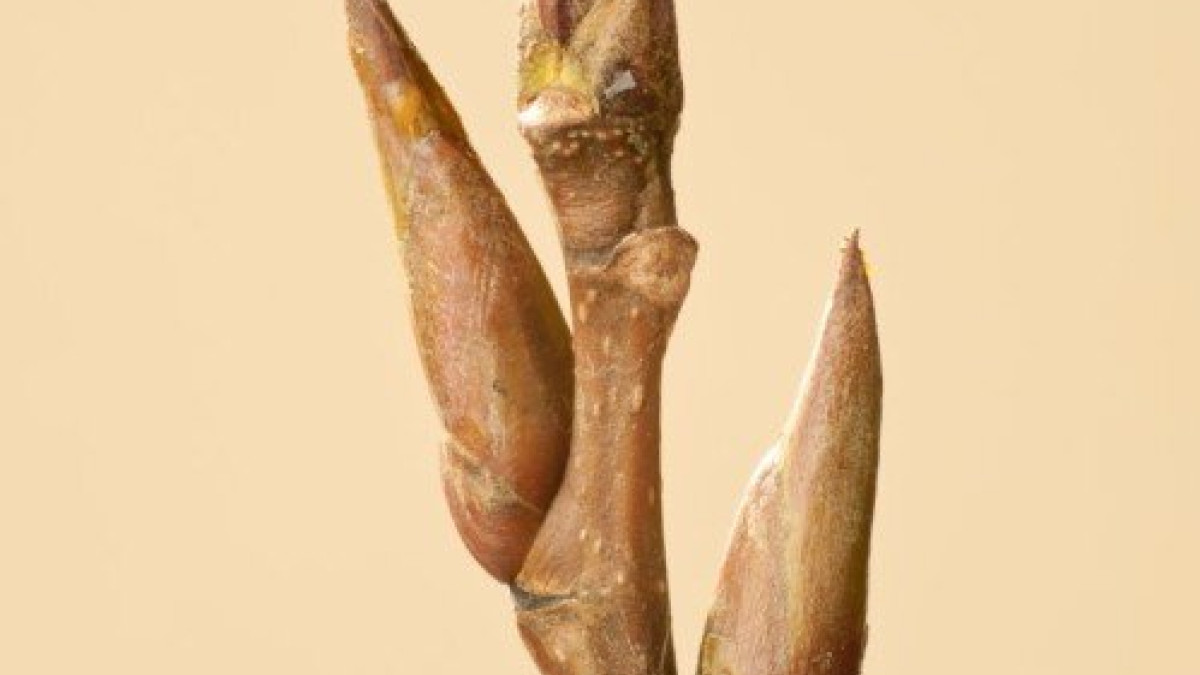
This is what the leaf of a Canadian poplar looks like